Del diario El Comercio, Lima
Ultima esperanza para la Cortarrama Peruana
Nota de PRWeb: Esta entrevista al ornitólogo Jeremy Flanagan apareció en
el diario El Comercio. Está dentro de la Campaña internacional para
salvar esta especie de la extinción. Por su importancia para el
conocimiento que debemos tener los piuranos sobre nuestra biodiversidad la
transcribimos para todos.
Talara. Propuesta
para formar quinta área protegida para la Reserva de la Biosfera del
Noroeste
¿Qué harías para
salvar una especie -cien por ciento peruana- de la extinción?
Nuestra rica y única biodiversidad está una vez más en peligro. Está
vez "Cortarrama Peruana" esta a punto de desaparecer. Todavía
hay tiempo, pero la extinción o no de la "Cortarrama Peruana"
dependerá de nosotros.
Nombrada en honor de
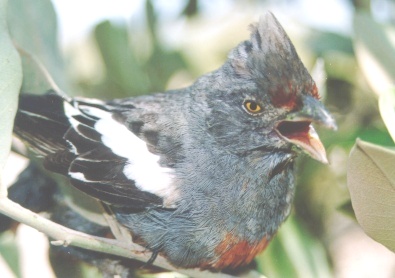
Antonio Raymondi, la Cortarrama Peruana (Phytotoma raimondii)
estuvo olvidada por más de un siglo y solamente era conocida en un bosque
pequeño cerca de Chiclayo. Sin embargo en 1998, el ornitólogo sueco
Gunnar Engblom encontró de nuevo a la especie en la provincia de Talara
después de 70 años sin registros. En base a esto, el año pasado,
ProAvesPerú, con el auspicio de PetroPerú, realizó un estudio en las
cercanías de Talara, confirmando la presencia de la ultima y única
población del ave, lo suficientemente grande como para tener la esperanza
de que la especie todavía puede salvarse de la extinción.
Con estas noticias
se han puesto en marchar una campaña internacional para salvar a la Cortarrama
Peruana. Para esta fase del proyecto ProAvesPerú ha logrado el
respaldo de la National Audubon Society de los los EE.UU., quienes con
fondos de la fundación de la Compañía de Walt Disney están auspiciando
el inicio del proyecto. También PetroPerú sigue respaldo el proyecto,
además de otras empresas petroleras como Petróleos Monterrico.
Como se sabe Talara
es un centro petrolero, y es justamente gracias a las empresas petroleras,
como PetroPerú, que todavía existe la Cortarrama Peruana y su
hábitat de bosque seco ralo en la Provincia de Talara. Esto se debe a que
por muchos años las empresas no han dejado que la gente ingrese a las
concesiones a destruir el bosque. Sin saber, la industria petrolera ha
salvado una especie de la extinción. Ahora las empresas saben de esto y
ven a la Cortarrama Peruana como un motivo de mucho orgullo y están
preocupados por su conservación.
La Cortarrama
Peruana es sumamente importante porque nos muestra lo que es el
verdadero bosque seco ralo, dado que es una especie indicadora. Su
supervivencia depende de una buena diversidad de plantas, lo que implica
poca o nula intervención por parte del hombre. El bosque seco ralo en su
estado natural casi ha desaparecido del Perú y, por tanto, del planeta,
dejando bosques dominados por Algarrobos - cosa que no se puede considerar
como un bosque seco natural-. La Cortarrama Peruana antes existía desde
Tumbes hasta Lima en una franja costeña, pero hoy su hábitat ha sido
casi completamente destruido o alterado. Como un ecosistema distinto, el
bosque seco ralo merece ser conservado, junto con la variedad de flora y
fauna que sostiene. Muchas de estas especies son endémicas y también
amenazadas. Es por eso que un componente clave de la nueva fase es la
propuesta para una reserva oficial y proteger este bosque, la Cortarrama y
las otras especies. Es importante el hecho de que, dada su ubicación,
esta reserva caería dentro de la Reserva de la Biosfera del Noroeste, un
conjunto de 4 áreas protegidas y reconocidas mundialmente por su
biodiversidad y alto nivel de endemismo. En este sentido, la propuesta
representaría la quinta área protegida de esta Reserva de la Biosfera.
Si la propuesta es aceptada por INRENA, significaría que la Reserva de la
Biosfera del Noroeste sería la más importante del mundo por su cantidad
de especies amenazadas.
Otro componente
importante en el proyecto es la educación ambiental que se impartirá en
los colegios de Talara y el departamento de Piura.
Varias entidades y
el público están solicitando que la Cortarrama Peruana sea declarada
como símbolo oficial de la provincia de Talara y el punto focal de todo
lo que representa la conservación de los bosques secos del noroeste.
Tanto ha sido el interés en este tema en Talara que muchos quieren
renombrar a la especie como "la Cortarrama Talareña". Sin
embargo falta mucho para asegurar su supervivencia para las futuras
generaciones. Pero parece que hemos llegado justo a tiempo para salvar un
importante parte de nuestra patrimonio natural.
|
| Peruvian
Plantcutter
Phytotoma raimondii
Conservation status:
IUCN: Endangered (B1+2a,b,c,e)
Distribution and Status
Historically only
known from 14 sites along the north Peruvian coast (Collar et al. 1992) at
which time it was classified as Endangered. In 1994 it was reclassified as
Critical (Collar et al. 1994), but with the release of Threatened Birds of
the World (BirdLife International, 2000), the species has been
reclassified again as endangered. However, this lowering in threatened
status does not clearly reflect the current status of the species.
In 1998/1999 the
Swedish ornithologist Gunnar Engblom revisited the 14 known historical
sites listed in Collar et al. (1992), with the worrying result of only
finding the Plantcutter extant at three of these sites. However Engblom
did find 3 new sites, two near Chiclayo and one further south. The 3
historical sites where the species was found are two near the coastal town
of Talara, and one near Chiclayo.
On the basis of the
Talara results, ProAvesPeru launched a wider investigation into the
species distribution around Talara, during July-August 1999. The results
found large extensions of the Plantcutters habitat and the species
distributed across a wide area. In comparison the known sites near
Chiclayo consist of small forest fragments of only a few hundred hectares,
whereas near Talara suitable habitat extends over a few thousand hectares.
The current known
distribution consists of a wide area in Talara, some four small forests
near Chiclayo and a further small forest further south from Chiclayo. The
total population is estimated between 500 and 1000 and it is estimate that
the habitat around Talara must hold at least 80% of this. The forests near
Chiclayo are extremely small and contain populations estimated in between
20-40 individuals.
Habitat
The Plantcutter’s habitat consists of a sparse desert scrub vegetation,
where large bushes are openly dispersed across the desert. The Plantcutter
is herbivorous and therefore requires habitat with a good diversity of
tree species for its diet. However, today this special type of dry forest
has all but completely disappeared or been altered by extraction or
animals, therefore bringing the Plantcutter to the brink of extinction.
Threats
The forests near Chiclayo are threatened by goat grazing, extraction of
firewood and timber and the total conversion of the land to sugar cane
fields. The forests around Talara have survived because they lie within
oil concessions, Talara being a main petrol-producing centre in Peru. This
has meant that over the last decades the companies controlling the
concessions have enforced strict security measures, not allowing people in
to destroy the forest. Therefore the natural habitat has flourished and
the Plantcutter as well. However, communities are present in some areas,
and firewood extraction and goat grazing is evident. Recently the gravest
threat to this habitat is an agro-industrial project, which will
effectively destroy at least half of the Plantcutters habitat in Talara.
Actions
The long-term security of the species will depend primarily on protecting
its stronghold in Talara. To this end the Peruvian NGO ProAvesPeru is
working towards the declaration of a reserve, although the area planned
for the reserve is included in the agro-industrial project. The work of
ProAvesPeru, supported by the National Audubon Society, will also include
environmental education within Talara, and other actions directed at
conserving and restoring the Plantcutters habitat.
References
BirdLife International. 2000.
Threatened birds of the world. Barcelona and Cambridge, UK: Lynx
Editions and BirdLife International.
Collar, N.J., Gonzaga, L.P., Krabbe,
N., Madroño-Nieto, A., Naranjo, L.J., Parker III, T.A., and Wege, D.C.
1992. Threatened birds of the Americas: the ICBP/IUCN Red Data Book.
International Council for Bird Preservation. Cambridge, U.K.
Collar, N.J, Crosby, M.J., and
Stattersfield, A.J. 1994. Birds to watch 2: the world list of threatened
birds. BirdLife Conservation Series No. 4. Cambridge, UK: BirdLife
International.
|
|